The Awards Connection

  • Home
  • The Oscars
  • Oscar Flashback
  • FYC Ads
  • The Golden Globes
  • The Guild Awards
  • Reviews
  • Lists
  • About Me
  • Articles
  • Podcasts
  • Twitter
  • Bluesky
  • Letterboxd

Review: "Moonlight"

November 07, 2016 by Andrew Carden in Reviews

When, early next year, I sit down and reflect on all of the cinema I viewed over the course of 2016, there is scant doubt in my mind that some of the most beautiful, moving moments I witnessed all year will have come from director Barry Jenkins' Moonlight.

For that matter, when I hang up my hat as a moviegoer a century (hopefully longer!) from now, I anticipate this exquisite film will rank sky-high on my list of all-time greatest coming-of-age stories.

The picture, based on Tarell Alvin McCraney's play In Moonlight Black Boys Look Blue, traces the life of young Chiron through three chapters, in his childhood, teen years and adulthood.

Nicknamed "Little" as a child, the timid, withdrawn Chiron is bullied by classmates and finds minimal comfort at home with his controlling, drug-abusing mother (Naomie Harris). His only solace comes in moments spent alongside his kind, empathetic best friend Kevin and a crack dealer named Juan (the brilliant Mahershala Ali) he befriends and slowly opens up to.

As a teenager, Chiron continues to face harassment at school, often violent, and his mother declines into full-out addiction. All the while, he still has Kevin to turn to, and their relationship blossoms into something so much more substantial and special. It also, however, is complicated by the peer pressures Kevin faces by classmates who despise and wish to inflict pain on Chiron.

The third chapter finds a far tougher and more tenacious Chiron in his adulthood. Now going by the name "Black" (given to him by Kevin back in high school), he emulates a key past figure from his life and maintains a shaky, long-distance relationship with his mother, who has at last sought to keep herself out of trouble. Chiron has not seen or spoken with Kevin in years but that changes one evening when he receives a phone call from his old best friend.

From start to finish, Moonlight is full of immensely powerful, often startling moments. Jenkins captures nuanced feelings of childhood in a way I haven't seen so vividly drawn since scenes from Terrence Malick's The Tree of Life. The picture is often a heartbreaker for sure but never manipulative and just about everything here rings true. While certain images from the first chapter have most stayed with me since seeing the film, I think Moonlight's dialogue especially comes to life in the final half hour, as Chiron sits down with the man who perhaps knows him best.

Ali and Harris have garnered the bulk of chatter in terms of awards season speculation and both are fantastic, no doubt. But it's a real shame if we neglect to just as loudly rave about the rest of Moonlight's incredible cast. Alex Hibbert, Ashton Sanders and Trevante Rhodes are devastatingly good as the child, teen and adult Chirons, respectively. Andre Holland is excellent as adult Kevin and Jaden Piner and Jharrel Jerome are strong too portraying him as a child and teenager. A real standout for me here was also Janelle Monae, warm and engaging in her scenes as Juan's wife and another of the few figures Chiron can count on - she has a bright screen presence that all but ensures a great film career to come.

I have came across some wariness to Moonlight from moviegoers who either view the film has a guaranteed downer or loathe cinema concerning drugs and won't check it out on that basis alone. To folks in either of those two groups - this thing is a real must-see, gorgeously filmed, stuffed with one extraordinary performance after another and featuring some of the sharpest writing I've encountered in the 2010s. Go!

A

November 07, 2016 /Andrew Carden
Reviews
Reviews
Comment

Review: "Christine"

October 24, 2016 by Andrew Carden in Reviews

A number of years back, in college, I composed a paper on the history of safety regulations in the film industry. A key focus of mine was the horrific accident that occurred on the set of Twilight Zone: The Movie in the summer of 1982 - that is, the helicopter crash that ended the lives of veteran actor Vic Morrow and child actors Myca Dinh Le and Renee Shin-Yi Chen.

While researching that event, I came across the now-defunct shock site Ogrish, which specialized in uploading graphic, gory multimedia of accidents, executions and so on, that would never be allowed to grace a mainstream video-sharing website like YouTube. Besides video of the accident itself, there were countless threads on their message boards discussing the Twilight Zone incident. There was even more chatter, however, about another grisly death once captured on film.

That marked the first time I'd ever heard the name Christine Chubbuck, despite at that point having already put in a few years toward my Bachelor's degree in Journalism. To the Ogrish crowd, Chubbuck was something of a legend, her suicide having been broadcast live on-air over the Sarasota, Florida airwaves in the summer of 1974. That video of this tragedy has never surfaced since its live airing made Chubbuck's death all the more intriguing to these online chatters.

At the time, I did a bit more digging - beyond the Ogrish crowd, of course - on her life and career but otherwise, in the years since, had not given a thought to Chubbuck.

Now, however, comes Christine, a motion picture focused on the final days of Chubbuck's life.

With the mesmerizing Rebecca Hall (who was so terrific in last year's The Gift too) in the title role, the film portrays Chubbuck as an immensely talented and committed journalist. Craving to report on serious issues of substance, even if it's dry material like zoning laws, she is constantly at odds with her boss (Tracy Letts), who wants juicier, more sensational stories to boost the flailing network's ratings. She's a standoffish presence at work but at least has the respect of her other colleagues (Michael C. Hall and Maria Dizzia among them).

Chubbuck, however, does not have much of a life outside the office. She has struggled with depression for years, having attempted suicide several times in the past. After graduating from Boston University's journalism school, she moved back down to Sarasota to reside with her mother (J. Smith-Cameron) and their relationship is often contentious, especially when her mom brings home a new boyfriend. Chubbuck dreams of moving up in the reporting ranks and starting a family with a wonderful man but several events - over what will prove the final days of her life - make those desires look all the more implausible.

Christine does not break a ton of new ground on the much-explored scene of 1970s journalism and we've seen the "serious vs. sensational journalism" debate tackled more compellingly before. The picture also goes on 10 minutes too long, ending on a note that just isn't very convincing. The look and feel of the time is, however, captured quite nicely, and the film sports a marvelous soundtrack. Beyond the warm and affecting Smith-Cameron, none of the supporting cast leaves much of an impression.

The picture is, however, well-worth a look for one reason, that of course being its leading lady. Hall gives a truly pitch-perfect, lived-in performance as Chubbuck. While Letts grandstands in a hammy turn as the network boss, Hall is brilliantly subtle here and not only heartbreaking but, given Chubbuck's self-deprecating nature, often very funny too. She particularly amazes during a roller coaster-of-emotions sequence in which Chubbuck is invited out to dinner by the network's lead anchor.

While pundits these days seem focused almost exclusively on the likes of Emma Stone and Natalie Portman, we should not this awards season overlook the sublime work here from one of Hollywood's most underappreciated actresses.

B

October 24, 2016 /Andrew Carden
Reviews
Reviews
Comment

Review: "The Girl on the Train"

October 09, 2016 by Andrew Carden in Reviews

Someday, Emily Blunt, you will (at last!) get that Oscar nomination. I'm afraid, unfortunately, this again will probably not be the year.

Going into The Girl on the Train, adapted from Paula Hawkins' big, fat hit of a novel, I was expecting something of a pale Gone Girl imitation. Reviews for the picture, after all, were embargoed until a few mere days prior to release and when notices finally did surface, they weren't too flattering. Given the raves for its leading lady, I figured the picture might well prove a repeat of something like Mommie Dearest, where the brilliant Faye Dunaway was stuck carrying a gargantuan pile of trash on her shoulders.

Thankfully, The Girl on the Train is no Mommie Dearest. It almost never reaches the heights of the aforementioned Gone Girl either, but it is an entertaining, plenty watchable erotic-psychological thriller. The picture at times rings of Adrian Lyne adapting a Jacqueline Susann novel.

In the film, Blunt portrays Rachel Watson, a woman reeling from the end of her marriage to Tom (Justin Theroux), who cheated on Rachel with Anna (Rebecca Ferguson). Every day, the alcoholic, blackout-prone Rachel passes by Tom and Anna's home while taking the train into the city but it is the sight of their neighbors Megan (Haley Bennett) and Scott (Luke Evans) that really piques Rachel's interest. She views the seemingly madly-in-love Megan and Scott as an absolutely perfect couple. So, when Rachel notices something unusual at their home, involving Megan's therapist (Edgar Ramirez), and then Megan suddenly goes missing, she cannot help but investigate, even as she cannot trust her own memory due to all the boozing.

Blunt is flat-out fantastic in the picture, perhaps even more amazing here than in last year's Sicario, and anytime she graces the screen, The Girl on the Train is completely engrossing. When it comes to on-screen alcoholics, it's a turn right on-par with the legendary likes of Ray Milland in The Lost Weekend and Mickey Rourke and Faye Dunaway in Barfly.

Unfortunately, the rest of the film does not quite operate at the same sky-high level. Bennett leaves a strong impression as Megan but the other ensemble players - sans Allison Janney, terrific (as always) as the detective investigating Megan's disappearance - don't seem as invested. The picture sports a polished, gloomy look, not unlike Gone Girl, but rarely musters the same suspense as that film. Danny Elfman's score is a nice fit.

Ultimately, if I have to point a finger at a single person for not delivering a more all-around satisfying film, it would have to be the picture's director, Tate Taylor, who also leaned heavily on the strength of his cast to make something out of The Help. That film had half a dozen or so marvelous performances, which effectively overshadowed the lethargy of Taylor's direction. This time around, Taylor recruited a cast that, for the most part, wasn't so willing to do such heavy lifting.

With that said, The Girl on the Train is still well worth a look, for both thriller fans and to see Blunt operating at the top of her game.

B

October 09, 2016 /Andrew Carden
Reviews
Reviews
Comment

Review: "Don't Think Twice"

September 17, 2016 by Andrew Carden in Reviews

I have to say, pumped as I am about this coming Oscar season, I haven't been terribly enamored with 2016's movie offerings. I've given a tinsy-winsy five films a higher grade than B+ and even my favorite film of the year (until this weekend), The Nice Guys, I only gave an A- and had a handful of qualms with. Nothing had left me head-over-heels.

That is, until (at last!) checking out Mike Birbiglia's second directorial effort (after 2012's Sleepwalk with Me), Don't Think Twice. It is handily the finest film I've seen in 2016 and it would have to be a uber-boffo Oscar season for this not to make my final top 10 of the year.

The picture, the All About Eve of improvisational comedy movies, often recalls the likes of Tootsie and Noises Off. It is also so. much. better. than fellow films of this genre like Punchline, Funny People and Mr. Saturday Night. Heck, Don't Think Twice simply has to be among the greatest pictures ever made about comedians.

In the film, Birbiglia portrays Miles, the elder statesman of the New York improvisational comedy troupe The Commune, who, for more than a decade, have been working their tail off at a tiny Manhattan theater, to modest-at-best fanfare. Miles, as he so often likes to put it, came "inches away" from once being cast on Weekend Live, a variety program that's a dead ringer for Saturday Night Live.

At one Commune show, a couple of Weekend Live producers stop by and invite members Jack (Keegan-Michael Key) and Samantha (the film's MVP Gillian Jacobs) to audition for their show. Jack, who has a penchant for showing off and upstaging his fellow Commune pals, nails his audition, while Samantha, who's shy to the idea of comedy superstardom, bails on auditioning altogether.

Jack's hire awakens loads of passive-aggressive resentment from the rest of the Commune, especially from Miles, who trained Jack in the art of improv, and leaves Samantha feeling lost at sea. Making matters all the more uneasy is announcement of the closure of The Commune's hole-in-the-wall venue.

Even if there's not a real "A-lister" among them, Don't Think Twice sports one of the most exciting ensemble casts I've seen grace the screen in a while. Beyond Birbiglia, Key and Jacobs, there's also Kate Micucci, Tami Sagher and, in a role that demands just as many dramatic as comic chops, Chris Gethard. Jacobs is particularly incredible here, devastatingly good on the impressions side (of Katharine Hepburn and Gena Rowlands, no less!) but also crafting an amazingly complex and engrossing character.

As for Birbiglia, I often found myself in real awe of just how pitch-perfect his screenplay is here. He has such an ear for dialogue, like a funnier Alexander Payne, delivering just as many thought-provoking lines as side-splitting ones. Sans his adorable work in last year's Trainwreck, I admittedly wasn't all that familiar with Birbiglia going into Don't Think Twice. After seeing this treasure of a picture, I'm eager for everything Birbiglia (and Jacobs!), past and present.

A

September 17, 2016 /Andrew Carden
Reviews
Reviews
Comment
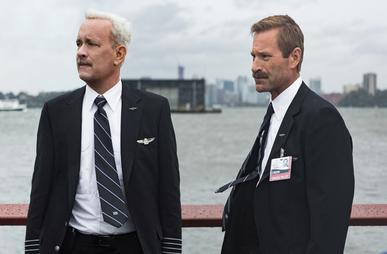
Sully 0.png

Review: "Sully"

September 10, 2016 by Andrew Carden in Reviews

Clint Eastwood is responsible for directing a handful of my all-time favorite pictures. I consider Unforgiven one of the finest westerns, not just in recent years but of all-time, rivaling even the greatest John Ford films. Million Dollar Baby is also a plenty powerful picture, as is Eastwood's fun and scary directorial debut, Play Misty for Me. Then you have The Bridges of Madison County, my favorite film of 1995, with my all-time favorite Meryl Streep performance - it's a truly exquisite, heartbreaking picture, directed with a beautifully gentle touch.

At the same time, Eastwood has delivered his fair share of duds too, from the clumsy and inert Bronco Billy and The Rookie, to overbaked Oscar bait like Changeling, Hereafter and J. Edgar.

Sully, Eastwood's latest effort - and let it be known first that I still consider the filmmaker a total badass, regardless of my coming comments - falls somewhere in the middle of not only the director's filmography but also leading man Tom Hanks'. It's a workmanlike, not terribly remarkable picture that, no pun intended, never quite takes off.

While Eastwood's film is not extraordinary, the events of January 15, 2009 most certainly were - that of Captain Chesley "Sully" Sullenberger's successful emergency landing in the Hudson River after a pesky flock of geese flew into and destroyed both engines on U.S. Airways Flight 1549. All 155 passengers and crew, including First Officer Jeff Skiles (Aaron Eckhart, doing his best work since Rabbit Hole), survived the ordeal and Sully was quickly thrust into the national spotlight as a beloved hero.

Despite this showering of praise, Sullenberger was challenged in the days following the event by the National Transportation Safety Board, whose members floated the possibility that Sullenberger may in fact have had sufficient power to land the plane at an airport. Much of the picture focuses on the pilot's efforts to prove otherwise, all the while trying to cope with this overwhelming overnight fame.

It's easy to see why Eastwood was attracted to this awe-inspiring story - and why not cast the indomitable Hanks as Sullenberger - but the film never packs a real punch. The event itself is well-choreographed and convincing but the picture is edited in a way that somewhat undercuts much of the tension - just as you're about to get on the edge of your seat, Eastwood cuts away from the action, and beyond the event and the film's finale (involving different simulations of the landing), the proceedings here often border on the lethargic. Flashback scenes touching on Sullenberger's pilot training seem to be out of an entirely different picture altogether.

Hanks is so understated as Sullenberger that he nearly fades into the background. It's commendable work but hardly among his finest. Eckhart breathes more life into the film and has better dialogue to boot (the writing here tends to recall a middle-of-the-road TV movie). But it's just sad to see heavyweights like Laura Linney (as Sullenberger's wife) and Anna Gunn (as one of the NTSB staffers) saddled with such thankless material.

Moviegoers love their Eastwood and Hanks, so this'll probably rake in upwards of $100M, but Sully is nowhere near the most interesting work either man has done.

C+

September 10, 2016 /Andrew Carden
Reviews
Reviews
Comment
  • Newer
  • Older

The Awards Connection
@awardsconnect